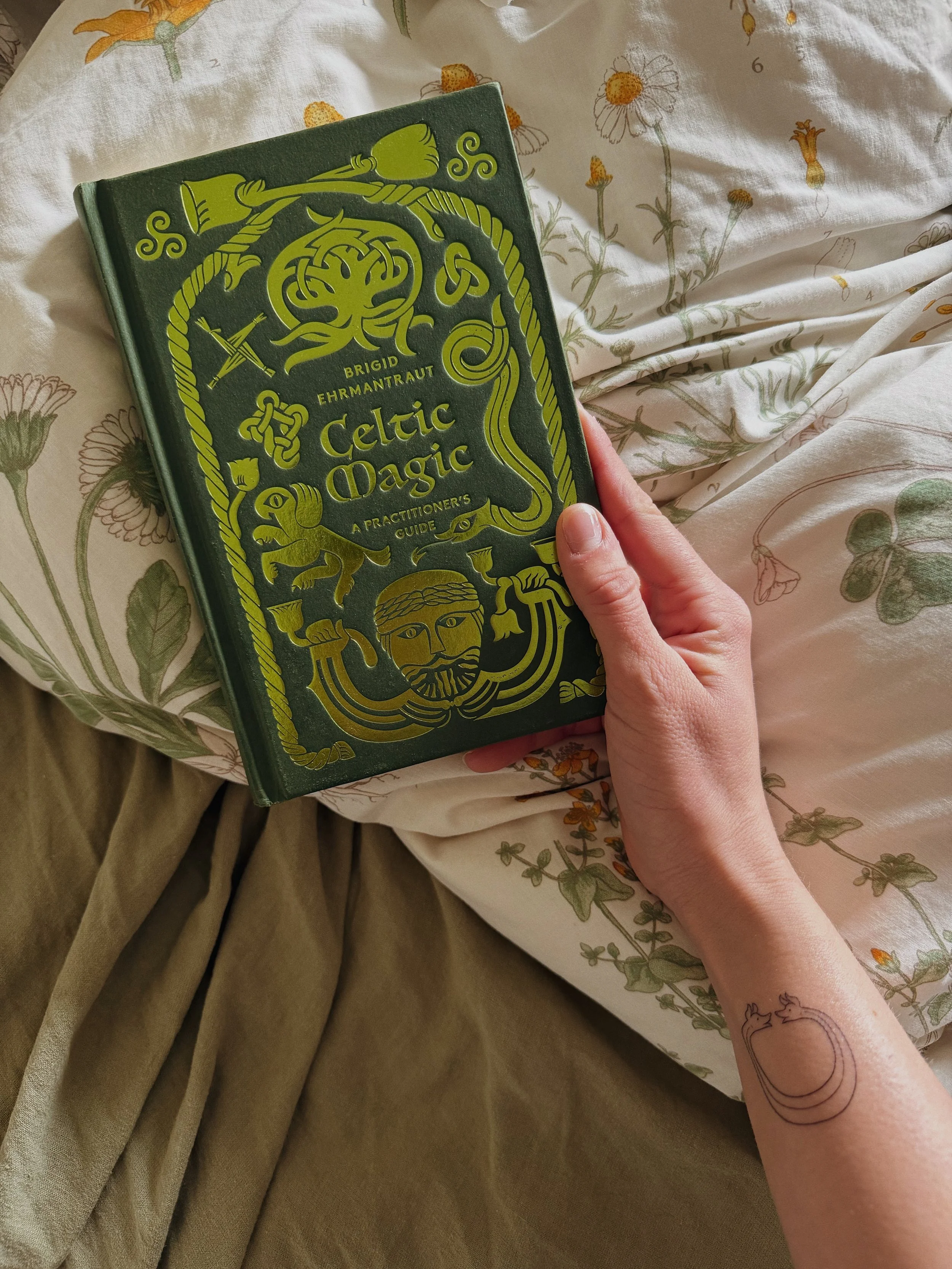
Firstly, thank you to Thames and Hudson for the finished copy of this book! It is absolutely stunning!
Bringing together a wide range of evidence including archaeological and written sources, Brigid Ehrmantraut embarks on what I would consider a challenging task of describing the rich history of Celtic magic. The book begins in the ancient world and moves through time to the present day and illustrates the changes in Celtic magic spanning over 2000 years.
Unlike Greco-Roman magic, mythology, and religion where we have a pretty solid foundation of knowledge regarding deities, stories, and beliefs of the people living during the period, it is far less straightforward in the Celtic world. The way the terms ‘Celtic’ and ‘magic’ were being used and defined was included in the introduction which was certainly necessary considering how complicated it can get using these terms today. For the matter of this book, ‘Celtic’ was used to refer to a language family associated with the material culture, literature and environment including Gaulish, Welsh, Breton, Cornish and others. There is also the slippery definition of ‘magic’ that has to be determined, which in ancient and medieval times was intertwined with the concepts of religion and nature.
The book is structured to move through time, beginning in the ancient world then moving through the medieval realm to the 20th century. The ancient world explored archaeological evidence for Celtic magic including curse tablets, ex voto dedications, sculptures and statues of deities (some known, and some unknown). Included in this first half is an interesting discussion on how we know about ancient Celtic magic and religion, and the syncretism that happened with Greco-Roman gods and stories that have obscured the Celtic roots.
The second half moves into the realm of medieval magic and uses medical documents, astrology, Christian saints and prayers, and the appearance of magicians in medieval literature more generally. Ehrmantraut follows Celtic magic and shows how it was changed adopted and adapted through time and across various beliefs and religions. There are also the fantastic additions of how you can practice Celtic magic today, using artefacts and literature from the past to inform a (safe) modern application.
This was a fantastic introduction to Celtic magic, and did a great job exploring its somewhat obscured history.