Review: The Maya Myths a Guide to the Gods, Heroes and Ancestors by Mallory E. Matsumoto

Firstly, thank you to Thames and Hudson for the finished copy of this book!

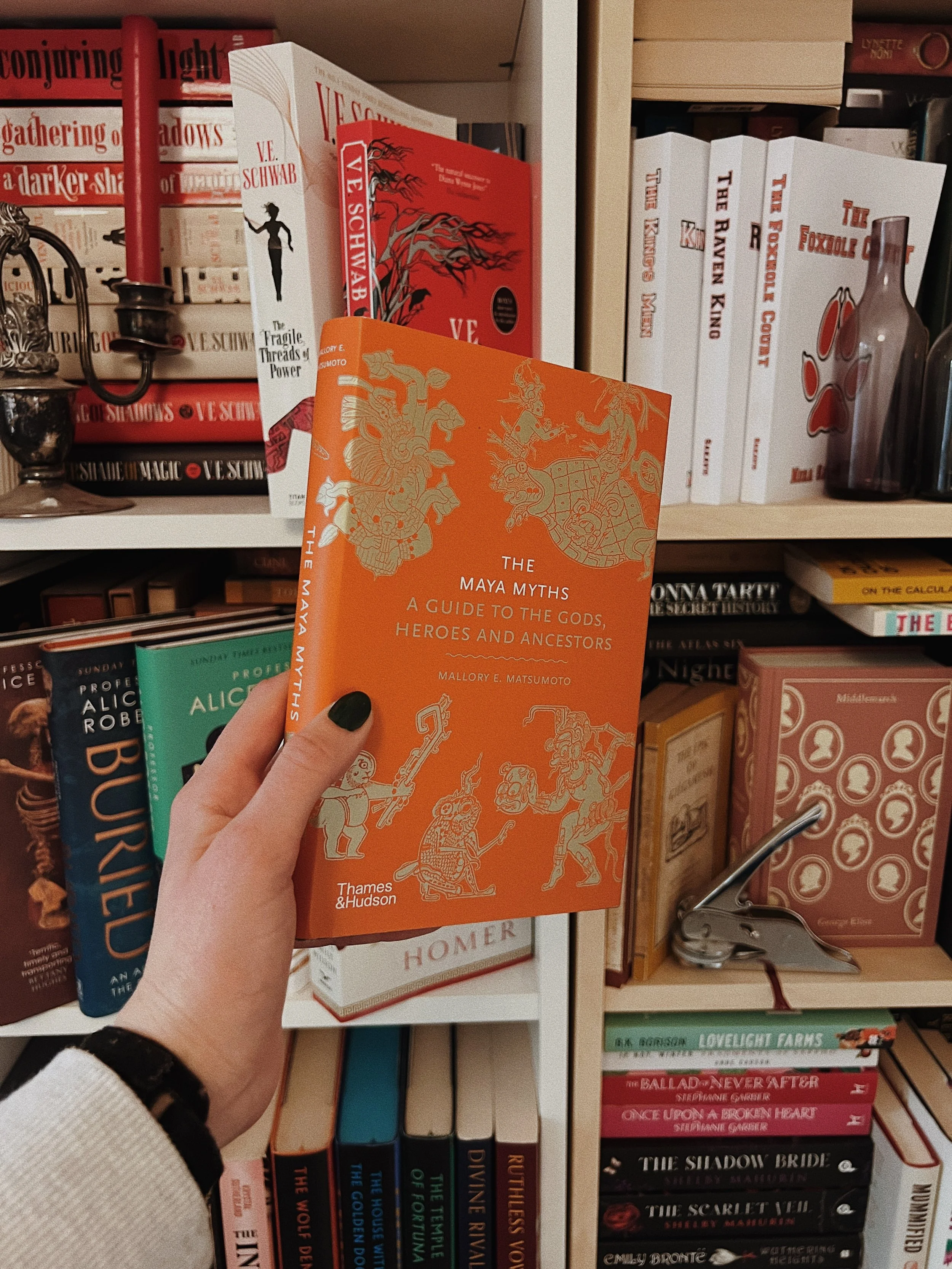
The Maya Myths by Mallory E. Matsumoto is the eighth instalment of Thames and Hudson’s mythology guides series, and has succeeded in packing a huge quantity of information into a relatively short book. Sitting at 209 pages and bursting with 103 illustrations, Matsumoto has delivered a perfect place to start for anyone looking to dip their toes into the rich history and mythology of the Maya. I personally really enjoyed the range of images throughout the book, including illustrations and artefacts.

From the beginning, this book provides maps, timelines, and a general overview of the Maya which is hugely beneficial for anyone just starting out on their Maya journey. The introduction also includes what we define as a myth, background information regarding Maya myths, the sources that they have been gleaned from, and a pronunciation guide. All of these details really support the reading experience and provide necessary contextual information for the layman.

The book is then separated into chapters; Creations, Sun and Moon, Heavens and Underworld, Milpa, Origins and Migration, Foundings, and Epilogue, providing narratives, historical context, and explanations of common themes and points of importance for the Maya. The Mayan mythology corpus that is available today could be likened to a puzzle where half the pieces are missing, and a quarter of the pieces are actually from a different puzzle all together. As noted by Matsumoto in the introduction, sources for the Maya myths span from the eighth century to the early twenty-first century, aspects have survived from pre-colonisation of the region, and some have survived following European and Christian influence from the sixteenth century. Myths have been reconstructed from the Maya hieroglyphic language, from colonial alphabetic texts, from ancient imagery and even collected and recorded by modern ethnographers.

Despite the puzzle work, there is so much to be learned about the Maya from their mythology including some versions of the fundamental beliefs surrounding the creation of the universe (cosmology), the importance of celestial bodies (the sun and the moon), the relationship between humans and divine beings, and even the reliance and significance of maize (corn) as essential to the Maya way of life up until the present day. Interweaved through the surviving myths are common themes that appear over and over, with a particular emphasis on dualities (sun and moon / good and evil etc). The range of Mayan identities can be understood from the varying regional differences, although some characters appear in many stories, and maize is always the most prominent foodstuff due to its significance in Mayan subsistence and daily life.

The book ends with a note on the modern struggles that began with the European colonisation of the Mayan regions, and the hardships that Mayan people face today. Beyond this, Matsumoto encourages the reader to contemplate how we interact and engage with narratives from the Maya and other Indigenous groups around the world.

I would encourage any mythology and history lover to expand their knowledge beyond the prevalent mythology of the Western world (Greece, Rome etc.) and pick up this well-written, highly illustrated and enjoyable introduction to the Maya people, their rich history and mythology.

2025 Reflections and New Beginnings

To say that I neglected my little corner of the internet in 2025 would perhaps be an understatement. The good thing about having hobbies is that they’re patient. So we’re back, another year done! 2025 was so busy, full of work and friends and concerts and new hobbies. It’s time to reflect, them look ahead! Let me know in the comments how your year was, reading or otherwise! Did you read some great books? pick up any new hobbies?

2025 reflection

my favourite reads of 2026

I always set a reading challenge as a personal choice to read more. In 2025 in particular, I wanted to limit scrolling and prioritise reading during my time away from work. With this in mind, I set my highest reading challenge number to date — 100 books — in an attempt to support choosing books over mindlessness and activities that are ultimately poor for my mental health. I am thrilled that I completed this literally on the final day of the year (after reading two of my shortest books). I think being intentional with reading during my downtime had a really positive effect on my general well being. In addition to this, I also got to read some really excellent (and some not so excellent) books this year. I didn't read quite as broadly as I have in the past, but I had a great time overall which is really all that matters. I read a lot of fantasy this year, and finally picked up many physical books that have been patiently waiting on my shelves for some time.

Along with working full time, I did a lot of living this year. I attended many concerts and dinners with friends and bagel breakfasts. I travelled a lot with work, saw a lot of the state and learnt a lot. I also picked up a new hobby - knitting! About mid-2025 I decided I would give knitting a try, and I have since made scarves, gloves, and sweaters. I wasn’t anticipating picking up a craft this year, but it became another excellent way to cut down on unnecessary scrolling. Knitting while watching tv is such a delightful after-work activity. Not to mention it has opened up a whole new creative outlet, topics to chat about with friends, and the incredible feeling of making something with your own two hands. I would recommend picking up some knitting needles in 2026!

2026 goals

I have set a significantly lower reading goal this year, in the hopes that I have developed some healthy habits from my test in 2025. If I read 40 books this year I will be stoked! In saying that, I would really like to read and review more of my non-fiction books I have stacking up which I know takes me much longer to read and digest. I would also like to, once again, prioritise books I already own in 2026 (which will hopefully be a bit more relaxed in the new-publications that 2025).

2025 christmas haul

We’re prioritising ~

  • reading books we already own

  • going analog (notebooks / diaries / printing photos)

  • knitting with yarn I already have / patterns I already own

  • taking more photos


Thanks for reading and here’s to a fabulous 2026 ✨

Review: Captive Queen The Decrypted History of Mary, Queen of Scots by Jade Scott

★★★★☆.5 | Book 10 of 2025 | thank you to Pegasus Books for the finished copy of this book!


Captive Queen The Decrypted History of Mary, Queen of Scots by Dr. Jade Scott is a new book focused on the life of Mary Queen of Scots, primarily during her period of incarceration in England by her cousin, Queen Elizabeth I of England. Even more specifically, Jade Scott has used Mary’s correspondence during this period to form the foundation of this book, and most significantly, includes some newly discovered letters. Dr. Jade Scott is a historian who specialises in Mary, Queen of Scots; her expertise in the queen’s letters and her passion, and respect for Mary clearly shines through. The book follows Mary, Queen of Scots, essentially from her second marriage to Henry Stuart, Lord Darnley and the troubles that ensued from that relationship through her third marriage to James Hepburn, 4th Earl of Bothwell, to her forced abdication from the throne of Scotland and her twenty year imprisonment in England before her execution on the 8th of February, 1587.

The concept of ‘decrypting’ is particularly interesting. Mary was often in correspondence with those in her confidence around plots and plans to free her from her imprisonment in England. In an effort to keep her letters secret, Mary and her correspondents wrote in cipher. The beginning of each chapter includes a single chosen cipher symbol that represents a person of interest that features in the chapter, as well as a quote from a letter, and a short, reimagined scene of Mary or one of her friends or confidants. It was a great way to initiate a chapter by easily framing the focus of it. Because of the use of letters as primary resources, there is a focus on Mary’s personal relationships with those who she was in contact with such as her cousin and captor, Queen Elizabeth I of England. There are also intimate insights into her letters to her son who she was unable to see past his infancy, and with those working to free her from her prison, with the lofty hopes of placing her on England’s throne.

Captive Queen does what I think many historical biographies and history books in general struggle to do, and that is bring the subject close to the reader, in that this feels like an intimate story of the second half of Mary’s life. Letters are in and of themselves, a more personal kind of resource, for in some cases we see Mary’s handwriting and her signature and the detail in which her ciphers were crafted that, as Jade Scott puts it in the preface ‘is like she is reaching out through time’.

This book is a perfect balance of up to date research and new discoveries, whilst being completely accessible to the general history enthusiast. I think it is so important to make cutting edge history and archaeology research accessible to the general public, and this book is an exceptional example of this. I had not heard about the discovery of the new ciphered letters from Mary, Queen of Scots, so in particular, I enjoyed learning about the new aspects of Mary and her correspondence that we have learned from these new documents. Of course, it is also nice when books include images to supplement the text, and this book included black and white images throughout it as well as two coloured image sections. The inclusion of images of full cipher keys, which is essentially a cheat sheet to be able to understand the cipher code letters were written in, was a highlight. Further, Scott has included both a Dramatis Personae at the beginning that lists all of the important figures that will be encountered in the book, and a helpful chronology / timeline at the end as a simplified rundown of the main events throughout Mary’s life.

Overall, I thought this was an exceptional book. It was easy to read, well researched (and referenced!) and used the letters in a way that supplemented the story of Mary’s life, whilst also illuminating new information we have learnt about the queen. I would recommend this to all lovers of history, and particularly to those with a love of historical texts, and of course, Mary, Queen of Scots.

Review: The Bone Season Series (So Far!) by Samantha Shannon

The Bone Season | ★★★★☆.5 | (read 2024)

The Mime Order | ★★★★☆ | (read 2024)

The Song Rising | ★★★★☆ | (read 2024)

The Mask Falling | ★★★★☆ | Book 2 of 2025

The Pale Dreamer | ★★★☆☆.75 | Book 3 of 2025

The Dawn Chorus | ★★★☆☆ | Book 4 of 2025

The Mask Falling | ★★★★★ | Book 5 of 2025 (I started writing this review whilst only 50% through — I guessed that this would be a 5 star read).


Talk about a juicy blog post! I took the plunge into Paige’s syndicate world, finally, at the end of 2024, and boy am I having a great time.

I have had the original version of these books sitting on my shelf for literal years, but when I heard that Samantha Shannon was republishing heavily revised versions of these books, I knew I had to wait until they were available before reading them. I both regret not reading this series sooner, and am really glad I waited for the authors revised editions.

It is very rare for a book series to have a compelling plot, diverse and complicated characters as well as being written well, but The Bone Season series certainly has all three. The Bone Season is set in a future, somewhat dystopian London where there are people with gifts, or clairvoyance, and those that do not, and England (along with some other countries) are controlled by Scion, who are hell-bent on eradicating those who they deem ‘unnatural.’ Paige Mahoney, our main character from Ireland, is an ‘unnatural’ with the ability to dream walk (essentially sending her consciousness beyond herself) and to detect other dreamscapes around her. She is a member of the underground clairvoyant community, the syndicate of criminals where she puts her gifts to use before being captured by Scion and sent to Oxford where chaos ensues.

The world that is so very like our world but not quite that Shannon has created is so intricate, and every detail has been thought of. You are immediately enveloped into Paige’s world, and you really cannot help but root for her. I won’t pretend that Paige’s life is an easy one, but she is truly a character that is, like us all, not without her flaws but continuously does her best with the hand she has been dealt.

The writing is exceptional. The writing is incredibly detailed, and it has this ability to really pull you into the world. I am not going to lie, there is an aspect of being thrown in media res with The Bone Season, and it can feel overwhelming when there are so many new terms being used. However, this series is worth sticking it out through what will inevitably be a confusing first few chapters. Before you realise it, you are familiar with the terminology and you become completely immersed in Paige’s London and Oxford.

I think there is often a critique of fantasy books that have characters that are hundreds of years old, or characters that are not human, but they are portrayed as no different than the young, female main character (essentially). This criticism that I think is often very valid is not one that can be assigned to this series. Arcturus is not of this world, and the Rephaim do not want to be human, and they do not act like humans. It is so refreshing to read a book that shows a clear contrast between our young main character who starts off in the dark and somewhat naive of the world around her, and the ageless otherworldly beings. That being said, the character growth displayed in this series is such a highlight in this series.

There’s not a lot that I can say without spoiling some aspect of this series, but I also think in the current political climate, a book that grapples with issues of censorship, media manipulation, and violent occupations of unwilling countries, this series is more important than ever. Anyone who says that books ren’t political have never read a book in their lives.

If you have read this series I would love to hear your thoughts! You can always find me over on Instagram @kell_read

Welcome 2025!

Some of my favourite reads from 2024!

Hello lovely readers and welcome to 2025. It is so wonderful to have you here in my little corner of the internet. I hope that 2024 treated you well and that your 2025 has begun smoothly.

I must first acknowledge my absence over here, and to a certain extent over on Instagram as well, in 2024. I spent the year completing my masters degree in archaeology and writing my thesis which, unsurprisingly, left little room for reviewing books. However, I am looking forward to getting back to my book reviews and recommendation posts this year. I have started work as a full time archaeologist, which means outside of working hours I am blissfully free of responsibilities.

2024 reading highlights

Before getting into 2025, it’s time for a little 2024 reading wrap up. Last year I read 82 books and 36,889 pages which I am stoked about. I do like to set a reading goal for myself each year, but it’s more that I hope I get the chance to read that much, rather than something I feel I need to complete each year. I would certainly prefer to read less books but all of them be books I really enjoy than read a heap that are average. In saying that, I have set my goal for this year to 100 books in the hopes that I find lots of time this year to relax and read! I have never read that many books in a year so who knows how it will go.

I primarily used fable last year to track my books, although I did use Goodreads as well, and I love the reading wrapped you get each year! In 2024 my average rating was 3.6 stars which isn’t too bad and my most read genre was fantasy / romantasy. My favourite books of the year were Pride and Prejudice, The Bone Season, Ancestors, Buried, Queen Macbeth., The Missing of Clairdelune and One Dark Window. I truly had such a great reading year with lots of different genres and authors.

The Year ahead

I personally don’t subscribe to the New Year New Me schtick, I am planning on being just as insufferable this year as I was last, but I do also feel like January 1st is like, the 9am Monday morning of the year. Translation: it makes sense in my brain as a good day to start some new habits. In 2025 I would like to prioritise my physical tbr, be more selective with buying new books, drink more water, write more reviews and read my horoscope each day. Do you make New Years resolutions? What are some habits or skills you want to pick up (or drop) this year?

I am currently working on a little series review for you guys (and if you follow me on Instagram, or Fable, or Goodreads you will have an inkling as to which series I am talking about)!

I also wanted to take this time to shamelessly self promote Whims & Fables, a bookclub that myself and two friends are hosting! Make sure to check out the dedicated page on here for the bookclub if you are interested in reading a fantasy book each month, and discussing it with a group of likeminded people!

Review: The Oxenbridge King by Christine Paice

★★★★☆ | Book 68 of 2024


The Oxenbridge King by Christine Paice is an intricate interweaving of historical fiction with the 21st century that deals with life’s big certainties, love, death, grief, truth, and family. In the beginning, the book follows a young man named Deadalus, a monk at the Abbey of Stern in the late 15th century during the end of the reign of King Richard III before his defeat at the battle of Bosworth. The narrative follows Daedalus in his heartbreak over the death of his king, and the soul of Richard, stuck in ‘Threadbare’, unable and unwilling to pass to heaven with the guilt and the grief of his choices on his shoulders. Then, we have Molly Stern, the Trembles, and Edward Farraday living in Oxenbridge in 2013, navigating life and loss in the 21st century.

Before battle with your beloved, fortify the body with toast and Marmite.

The story was inspired by the discovery of the bones of Richard III in 2012 under a car park in Leicester, and while the reinterment of the remains certainly does have its place in the book, Richard III acts as this tenuous link between all of our characters, playing a different role in the lives of each of them. You don’t need to know anything about Richard III or English history to enjoy and appreciate all this story has to offer. The narrative is very character driven, which will not be for everyone, but it certainly was for me. Without a doubt, it’s a weird, strange tale full of human emotion, and the best way to enjoy it is to let the story unravel in front of you, because it will all make sense in the end.

They take notice of him without knowing why. His body at peace with all the contradictions it inhabits. Confidence does that. Confidence in purpose, in the corridor of knowing between the outside and inside.

Raven (yes, an actual raven) was undoubtedly my favourite character in this book, and the sheer ingenuity behind the story is a wonder to read. From reading this, I would like to read more of Paice’s work because her prose is enchanting. The seamless transitions between character perspectives gives the narration an intimate quality that allows the reader a front row into the lives of these delightfully English characters. These characters, their thought processes and interactions felt so real, whilst the entire story had a completely unreal, dreamlike quality. A lovely, strange book that I enjoyed immensely!

“Out of all the souls on the battlefield, this one truly believed he was good. So I shows him, in his great and stumbling afterlife, he’s both good king and bad king. It’s a balancing thing.

Review: Twilight Cities by Katherine Pangonis

★★★★☆ | Book 48 of 2024 — another exquisite book from Katherine Pangonis.


Twilight Cities: Lost Capitals of the Mediterranean is Katherine Pangonis’s second book, with her first being Queens of Jerusalem: The Women Who Dared to Rule. Twilight Cities is dedicated to the history of five prominent and ‘lost’ cities from history: Tyre, Carthage, Syracuse, Ravenna, and Antioch. This book seamlessly blends Katherine’s personal experiences and travels through the modern areas and ancient remains of these once glittering jewels of the ancient and medieval world, and the sweeping histories of each of the cities from their inception to their decline and transition into modern spaces. Interwoven through the historical and archaeological evidence for these places are the myths and legends, most significantly their founding stories and legendary figures associated with them. Katherine’s sparking prose sweeps the reader along for the ride, as if you were walking alongside her.

The book has been dedicated both to the people of the Mediterranean that Katherine came across on her travels, but also those who lost their lives and livelihoods during the devastating earthquakes of 2023. This catastrophic event that rocked the city of Antakya (ancient Antioch) is often referred to through her own personal experience with the natural disaster, and essentially becomes another layer in the long history of the city. It gives the reader a feeling both of sadness, and of heightened awareness of the ‘sameness’ of the ancient world and the modern.

The names of Tyre, Carthage, Syracuse, Ravenna and Antioch have endured, but the true reality of the ancient cities have been lost. These cities are not the same as they were, and their glory has dimmed. But a city only dies when the ideas it was built with fade, as much as when fires tear down its walls or earthquakes shatter them. The ideas of these cities have persisted. Their memories remain. Not always necessarily in the minds of the residents, but preserved in texts, and the stone monuments that still grasp the earth around the Mediterranean. The air in these cities hang heavy with legend. (254)

Each chapter, which is dedicated to a different city, begins with Katherine’s personal history of the city. This includes her first visit to the city (such as her first visit to Syracuse at the age of twenty-one), and also gives the reader an insight into the city today and what you might expect to see if you were to visit. Then, each city is explored chronologically, starting with the founding of the city (both real or mythological), and then moves through time to the present day. By the end of the chapter, the reader is left with an intimate knowledge of the changes the city has gone through, it’s periods of strength and weakness, and all of the different groups of people who one called it home. This breadth of information is conveyed through the use of surviving texts with the archaeological remains of the cities.

The book is supplemented with a map at the beginning to orient the reader within the wider region, and the geographical spread of the five cities of interest, as well as an insert of colour images depicted some of the key places and people explored in the book. Additionally, each chapter starts with a quote to set the scene, and a lovely illustration. If you listen to the audiobook (well-narrated by Katherine herself), a PDF is also supplied with these supporting graphics.

I thought this was a wonderful book, beautifully written (and narrated), bringing these once glorious cities back into the limelight. Their long, and sometimes arduous histories, are recounted in a way that lets each city have its own moment to shine, but also highlights its interconnectedness with the other cities featured in this book (as well as the wider Mediterranean world). Many figures pop up numerous times and some events are mentioned in multiple chapters which allows the reader to grasp how interlinked this part of the world is, and has always been.

Review: Buried: An Alternative History of the First Millennium in Britain by Alice Roberts

★★★★☆ | Book 18 of 2024 — another wonderful book from Alice Roberts highlighting stories of the dead in Britain, and what bones and burials can tell us about past people.


Buried: An Alternative History of the First Millennium in Britain by osteoarchaeologist and professor Alice Roberts is the second book in her trilogy unpacking Britains history through skeletal remains. Following from Ancestors which focuses on the prehistory of Britain in seven burials, Buried instead focuses on Britain in the first millennium CE, through Roman Britain, contact with the Vikings and the spread of Christianity across the country. Roberts utilises modern and up to date evidence including skeletal remains, archaeological evidence, and DNA research to interrogate what we know about Britain during this period, and how we know it.

Probably because it spans a period where there is more available evidence from various contexts, Buried, spends more time discussing the more general historical environment, and contextualising the burials within a wider picture. The first chapter delves into a fascinating Roman cremation burial at Caerleon called the ‘Caerleon pipe burial’ named so because of the lead pipe sticking out of the top of the lead canister full of cremated remains that would have once stuck out of the ground. Roberts discusses the potential explanations for this unique burial, while also highlighting the historical period of Roman Britain more broadly, and the history more specifically of Caerleon. You finish the chapter feeling as though you were taken along for the ride whilst Roberts evaluated the various possibilities of the person buried, and why they had a lead pipe connecting their burial to the living world above them.

This is the general set up for each chapter focussing on a different part of the United Kingdom, and a different burial. The second chapter explored a Roman villa associated with numerous infant burials, and another chapter introduces the overall concept of ‘deviant burials’ which essentially means irregular or strange burials, and this concept is introduced with the headless skeletons found at Great Whelnetham. These burials were decapitated, sometimes with the skulls found between the legs, and some were even prone or face down. Roberts discusses Anglo-Saxon history in Britain (and even delves into the issues of using the term ‘Anglo-Saxon’ in the first place) and broadens her discussion even further with the Staffordshire hoard and the issues archaeologists face when dealing with hoards of artefacts.

By the end of the book, after learning about Roman Britain, Anglo-Saxon history, Viking connections and even the very first churchyards used as cemeteries, the reader truly feels well versed in the various and wide-ranging burial practices that were utilised in Britain during the first millennium. I think Roberts does a wonderful job at connecting the modern reader with the ancient inhabitants of Britain, reminding us that they, like us, were individuals who lived lives that didn’t necessarily fit a mould, as highlighted with the range of burial goods, and the numerous deviant burials. A wonderful addition to this book was the colour images insert, and the lovely illustrations at the beginning of each chapter that set the reader up for the kind of burials and artefacts featured in the coming section. As with Ancestors, I feel like having maps throughout, or one map at the beginning highlighting all the areas discussed would be really beneficial, especially for those not from Britain.

Overall, this was a fascinating, well-written and insightful analysis of Britain in the first millennium, utilising the most recent evidence and the authors incredible expertise.

Review: Ancestors: a Prehistory of Britain in Seven Burials by Alice Roberts

★★★★☆.5 | Book 16 of 2024 — one for all my archaeology enthusiasts and those interested in what our bones can tell us.


Ancestors: a Prehistory of Britain in Seven Burials is a focused yet detailed look at the prehistory of Britain, and particularly what burials, skeletons, ancient DNA and human remains can reveal about the long-spanning time from the Palaeolithic right up to the Iron Age. Professor Alice Roberts is an osteoarchaeologist and physical anthropologist, and she brings her expertise in all things skeletal to the fore in this book. Roberts takes the reader on a journey through time and around the United Kingdom, from the Red Lady of Paviland Cave dating to the Palaeolithic to the Neolithic ‘Tomb of the Otters’, to visiting Rushmore Estate and essentially doing archaeology of archaeology, and exploring the possibilities of modern technologies and ancient DNA.
Alice Roberts has included so much information in this one book, analysing seven burials from Britain’s prehistory, but going far beyond just the skeletons and remains themselves, it’s quite astonishing. The author doesn’t simply explain the remains, the person likely buried and what we can learn from them, but goes beyond this to consider wider themes such as sex and gender, burial rites and customs, and cultural beliefs. Various modern archaeological techniques are explained and utilised including isotopic analysis, radiocarbon dating, and ancient DNA and genome testing.

Beyond this, Roberts highlights issues related to each of these burials, including preservation bias and explanations of different taphonomic processes affecting remains and the archaeological record more broadly, issues of confirmation bias and those biases archaeologists of the 19th and 20th centuries brought to their works and analyses, as well as the simple fact that often, we can ever truly be sure of many things when it comes to archaeology, and the importance of delving into each potential explanation.

As someone not from Britain, I personally got a bit lost with the whereabouts of cities, areas, and sites mentioned, but perhaps there are maps in the physical copy that supplement this. Further, the only detraction for listening to the audiobook is not having any sort of imagery to help illustrate points made by Roberts, but overall I would still recommend the audiobook. Roberts has such a great way of narrating that makes you feel like she’s bringing you along for the ride! Additionally, the book begins at the Crick Institute in May 2019 and spends the first chapter discussing the exciting new ancient DNA works with the sequencing of a thousand ancient genomes. However, because of COVID-19, the project was placed on hold which meant that the new DNA information was perhaps not available for this book - here’s hoping the second book Buried includes some of what I am sure will be fascinating discoveries!

When reading through this book, you not only get incredible archaeological and historical information about these burials, but you also get a firm understanding of the modern context of the remains (i.e. where they are kept, if there is modern research happening on them etc.), as well as their historical context. This includes who initially found the remains, how they were excavated and handled, and broad contextual information about the find site, essentially bridging between their discovery, and this book.

Roberts’ self-aware and detailed discussion and analysis of the burials, the associated grave goods, culture and history (both ancient and modern) coalesce into a detailed, informative and enjoyable book that all lovers of prehistory and archaeology should read.

Review: The Fragile Threads of Power by V. E. Schwab

★★★★★ | book 82 of 2023 — a truly magical return to the world of Shades, through both familiar and new eyes. A must read for all lovers of the Darker Shade of Magic trilogy.


The Fragile Threads of Power by V. E. Schwab is the newest book in the Darker Shades of Magic world, initiating a new trilogy beginning seven years after the conclusion of A Conjuring of Light. In addition to the familiar characters of Kell, Lila, Rhy and Alucard, we are introduced to new characters like Kosika the White London Queen, Tes the tinkerer who can manipulate the threads of magic, and the new Queen of Red London (among others). It is a testament to Schwab’s skill that I loved being in the POV of Tes as much as I did the original characters and I am so looking forward to reading more from her POV (hopefully!). I have always liked White London POVs the least, but the inclusion of Kosika really held my interest.

Threads of Power incorporates a masterfully detailed plot, leaving the reader eagerly anticipating the next book. The world that we thought we were well versed in at the end of the original trilogy continues to be expanded as the secretive rebellion force The Hand is prowling the city with the intent of killing the royal family. Of course, chaos and adventure and magic ensues.

I think one of the aspects of this series that makes it so engrossing is that Schwab’s characters are unlike any other character I’ve read - there is no need for Lila to stop being pointy and geared for violence 95% of the time, and there is no need for Kell to stop being a mildly grumpy worrier 95% of the time. It doesn’t mean we don’t see a change in them, but they don’t stop being who they at their core, just because they are seven years older and in a different circumstance than they once were. Schwab represents the whole spectrum of humanity, and it is because of this, I think, that this series is still a favourite of mine. Seeing lovely moments between Kell and Lila, and between Rhy and Alucard made my heart melt, not to mention the personal growth they have all gone through. Reading this book truly felt like coming home.

If you have read the original trilogy and this new instalment, let me know what you think of it in the comments or over on my Instagram @kell_read!

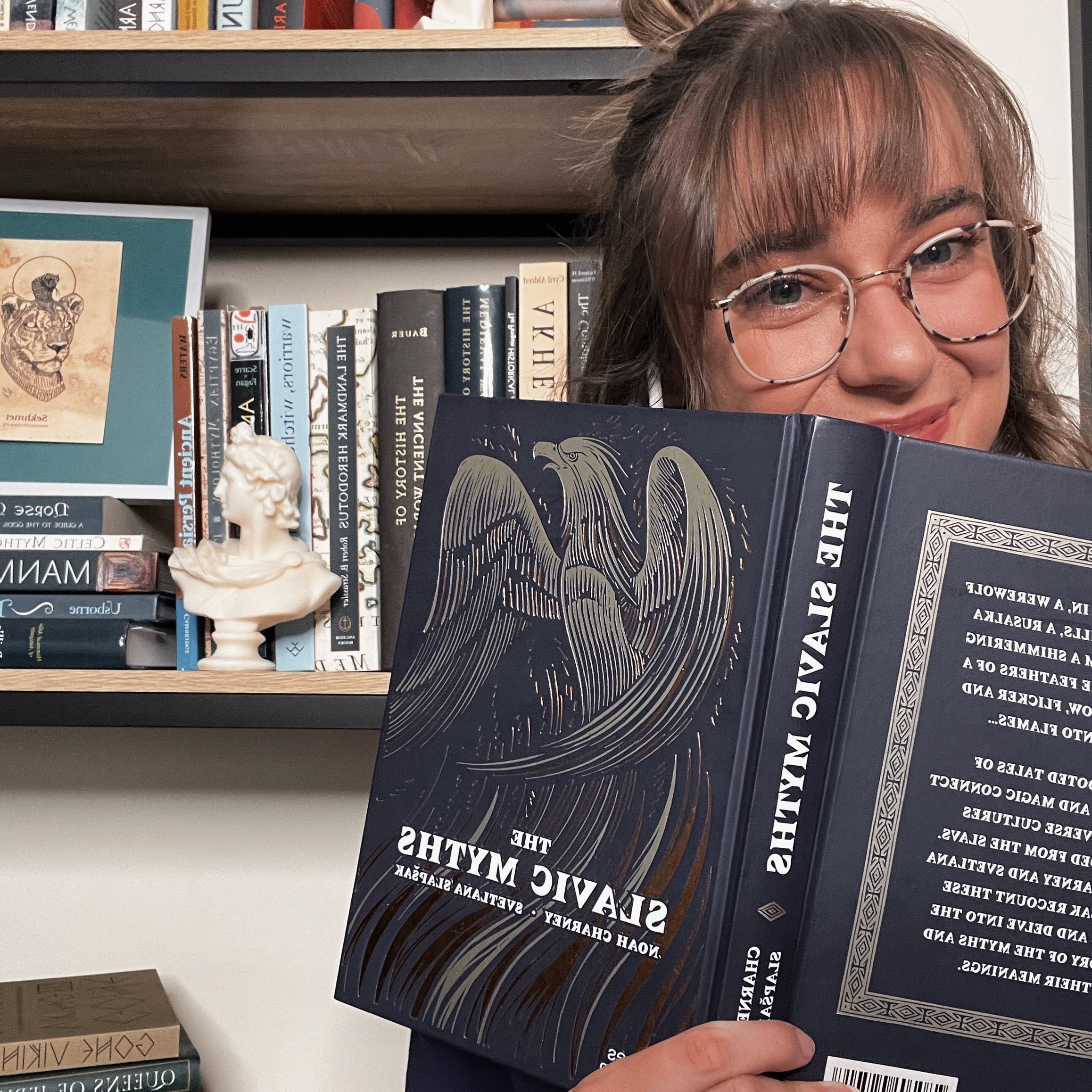
Review: The Slavic Myths by Noah Charney and Svetlana Slapšak

★★★★☆.5 — I was provided a finished hardback copy from Thames and Hudson — thankyou!

Keep your eyes out for my interview with Noah and Svetlana that will be going up on YouTube with World History Encyclopedia very soon!


The Slavic Myths by historian Noah Charney and anthropologist and historian Svetlana Slapšak is a wonderfully written and beautifully illustrated book delving into various Slavic myths, gods, and supernatural figures and the history behind them. The Slavic Myths is structured in eight chapters, including the introduction to the book, and the Slav Epic. Each chapter includes a new retelling of a myth, reimagined by Noah and Svetlana, followed by a section on the history of the myth and numerous important features within it. This is not a compilation of everything we know about Slavic mythology, but instead, seven hand-picked stories accompanied by accessible academic analysis, allowing the reader, whether they be well versed in Slavic myth or brand new to the corpus of tales, to enjoy the stories, and if they wish, develop their understanding of the myths and history further. Readers of The Slavic Myths can read the book from cover to cover, or they can jump in and just read a chapter at a time — they can just stick to the compelling reimaginings of the chosen myths, or they can dive into the historical analysis of each section. Either way, with the book being a combination of retelling and non-fiction, it can be enjoyed by all!

Slavic mythology is not as clear cut as classical Greek and Roman mythology, there is no equating the Greek king of the gods Zeus with any king of the gods figure in Slavic traditions. Noah and Svetlana had a huge task ahead of them with this book, with Slavic mythology originating first as an oral tradition, and then only being written down in the 19th century, but with specific goals for lending authority and adding history to new cities, and overlain with Christian morals and motifs. As mentioned in the book, a ninth-century Slav would not necessarily recognise their myths today in the form they now take — however, Noah and Svetlana have essentially added a new layer to this ever-developing and rich corpus of stories, deities, and creatures.

This book was a wonderful introduction to Slavic mythology. Upon picking it up, I had a vague familiarity with Baba Yaga, her house with chicken legs, and the creatures of firebirds. Beyond that, I was completely unfamiliar with the Slavic pantheon, or the history behind the myths and tales. What really captured my attention (beyond the stunning woodcut imagery throughout the book), was the first creature, the vampire, which has its roots in Slavic myth. And not only that but in Slavic tradition, the vampire and the werewolf were intrinsically linked creatures! I learnt so much about the history and development of Slavic myths, and particularly enjoyed the analysis of folklore versus fairytales versus mythology, and the creation of myths with ‘mythurgy.’ I was intrigued to find parallels with classical Greek tales such as Jason and the Argonauts, to find hints of well-known fairytales such as Cinderella and her horrible stepmother and stepsisters, and aspects of Ovid’s Metamorphosis with the trials Venus has Psyche complete, all solidly within the world of Slavic mythology. I didn’t know that throwing a coin over my shoulder into a fountain or body of water originated as a Slavic ritual in fear of the dead — did you?

I could not recommend this book enough for those looking to dip their toe into some new myths, or for those who are looking to read a new version of their old favourite Slavic myth.

Review: Lost Cities of the Ancient World by Philip 'Maty' Matyszak

★★★★☆.5 | — I was provided a finished hardback copy from Thames and Hudson — thankyou!

You can also watch my interview with Maty all about this book on YouTube with World History Encyclopedia!


Lost Cities of the Ancient World by Dr Philip ‘Maty’ Matyszak compiles lost cities from around Europe, the Middle East and Asia into one volume, linking cities thousands of years and thousands of kilometres apart with the simple fact that in some way or another, they are or once were, lost. Following on from his earlier book Forgotten Peoples of the Ancient World, Maty introduces and reacquaints his readers with cities that were abandoned, sunk or destroyed many years ago, and he does so in an engaging and exciting way. This book, aimed at the general history enthusiast, still includes pieces of fascinating history that those acquainted with the sites might not know. Despite being familiar with many of the sites explored in the book, I not only learnt something new about many of them, but was also introduced to various sites I had never heard of. Of particular fascination to me are the submerged cities of antiquity, lost to us beneath the waves and rising seas, which made learning about Thonis in Egypt one of the highlights of this book.

Lost Cities is a book that is so wonderfully accessible, so vibrant and full of incredible imagery, but also informative and a joy to read. The book is split up into general time periods ranging from the Neolithic and oldest cities of Çatalhöyük and Skara Brae to cities within and on the edges of the Roman world. This book could be read from beginning to end, travelling in time and space, or you could just as easily dip in and out, reading of Troy one day, and Palmyra the next. With that in mind, it would be difficult for this book not to capture everyone’s interest in some way or another, with the wide range of sites and civilisations discussed.

Considering the geographical and temporal range of the book, each city is presented drawing on a range of available evidence. Each place is shown on a map, and followed by the introduction of archaeological, and where possible, textual evidence of the city. For example, when discussing the infamous city of Troy, Maty draws upon the Iliad to discuss the mythological importance of the city, and for the city of Persepolis, texts composed by Darius the Great highlight the city's political importance. Overall, the interconnectivity of the ancient world runs as an undercurrent to the book with an emphasis on the trade and movement of people, things, and ideas.

Much like Egyptian Mythology - A Travelers Guide from Aswan to Alexander by Garry Shaw, Maty not only introduces the history of a city, its humble beginnings, times of strength and its descent into obscurity, but he also includes the city today. Great for those who want to know if these cities are still physically lost, or may want to visit them one day to check for sure that they really have been found, Maty divulges the current state of the city, and what a tourist today could expect to see when on a visit. This book does a wonderful job of introducing the most important sites in the relevant regions that have been lost in some way or another, and brings them back into the public consciousness. I thought this was a wonderful book introducing numerous important cities from the ancient world and would recommend it to those who love the ancient world, and those who love a book with incredible imagery.